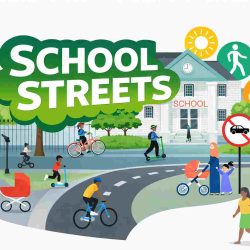
Cities around the world face multiple challenges in terms of ensuring high quality of life for their residents, including the rise in air and noise pollution, worsening urban-heat waves in light of climate change, and limited access to open and green space, especially for children. Two global cities, Paris and San Francisco, are attempting to address these issues via a radical reimagining of their streets – the most ubiquitous form of public space. Indeed, both have pedestrianized entire streets in front of schools, though at different paces and to different extents. Paris’s program, ‘Rues aux écoles,’ recently surpassed 200 locations, which has entailed a wholesale closing of these streets to automobile traffic, along with the addition of heat-reducing pavement, landscaping and tree planting, seating, bicycle parking, and even toy and book lending libraries. The “Rues aux écoles” observatory conducted by the NGO La Rue Est à Nous (2024), identified several types of School Streets interventions in Paris, from partial to full street closures.
In both cities, School Streets programs aim to increase children’s access to open space, to make their travel to and from school safer, and more broadly, to increase the social connectivity and ecological health of neighborhoods, for the benefits of parents, residents, and small businesses as well. As of 2022, cities from across 17 countries had implemented school street programs, primarily in Europe, North America, and Australia (FiA Foundation, 2022), indicating broad interest in quantitative and qualitative evaluation of the potential benefits of such street re-designs.
In both Paris and San Francisco, School Streets have yet to be systematically analyzed, indeed, the recency of these programs means their inclusion in academic research has been limited (Aldred and Croft, 2019). Given that, we propose an ambitious analysis of their quantitative impacts on transportation behavior, air and noise pollution, urban heat, as well as their influence on social connectedness of the school communities and neighborhoods they lie adjacent to.
Specifically, we propose deploying a range of sensor technologies to measure the mobility and ecological changes occurring on School Streets, as well as conducting interviews and fielding surveys among the parents, teachers, and neighbors of these schools in order to understand how these re-allocations of public space are altering the social dynamics of these public spaces and communities. In both Paris and New York, we will select four schools that cover a broad range of School Street types, as well as neighborhood socio-economic demographics, and partner with local education and transportation departments/authorities to conduct the project.
Partenaires
Marcel Moran, San José State University (USA)